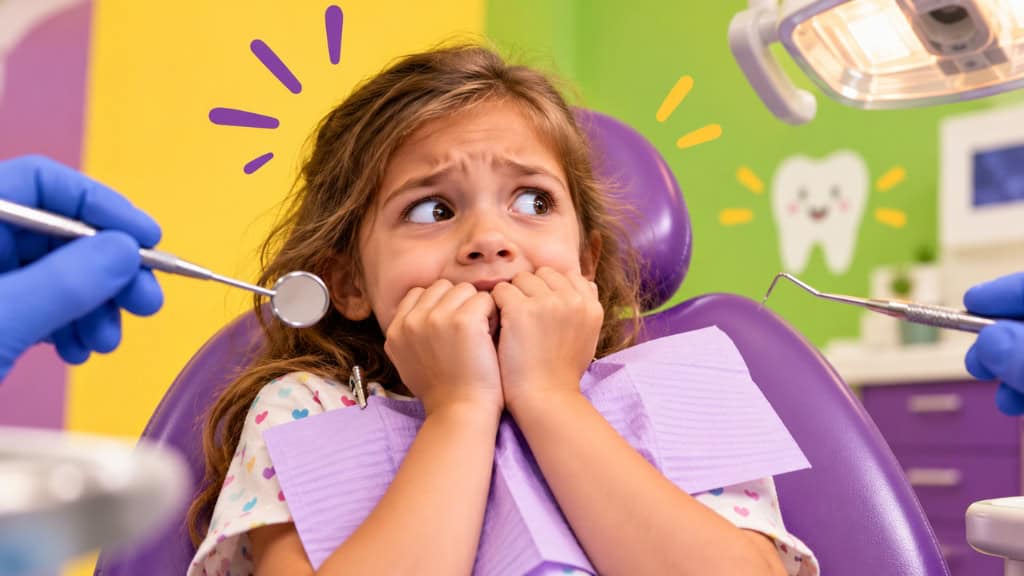
Many parents ask themselves: “At what age should my baby make a first visit to the dentist?” It’s a proven fact that dental care at the youngest age possible goes a long way. Build excitement and understanding. Kids are smart! Hope to see you and your baby soon! Make an appointment with a baby dentist today.
Dental hygiene is important for everyone – including babies. It is important for parents and caregivers to take an active role in caring for their baby’s teeth by cleaning them at home, providing a balanced diet and scheduling regular dental check-ups.
A common misconception is that primary or “baby” teeth are not important because they will eventually fall out. On the contrary, a child’s first set of pearly whites sets the stage for good overall health.
Primary teeth are important for chewing and maintaining a healthy diet, facial development and preparing the jaw for the arrival of permanent teeth.
Unfortunately, tooth decay can begin as soon as the teeth emerge, as early as six months of age. Decay in the primary teeth may cause pain. It can also harm erupting permanent teeth developing inside the gums.
The good news is that tooth decay is totally preventable by following some simple, basic tips from baby dentist Dr. Cameron Zealand.
First, never allow a baby to fall asleep with a bottle containing milk, juice, sweetened liquids or a pacifier dipped in sugar or honey. This causes Baby Bottle Tooth Decay (BBTD) or more commonly known as Early Childhood Caries (ECC), the leading cause of dental decay in young children.
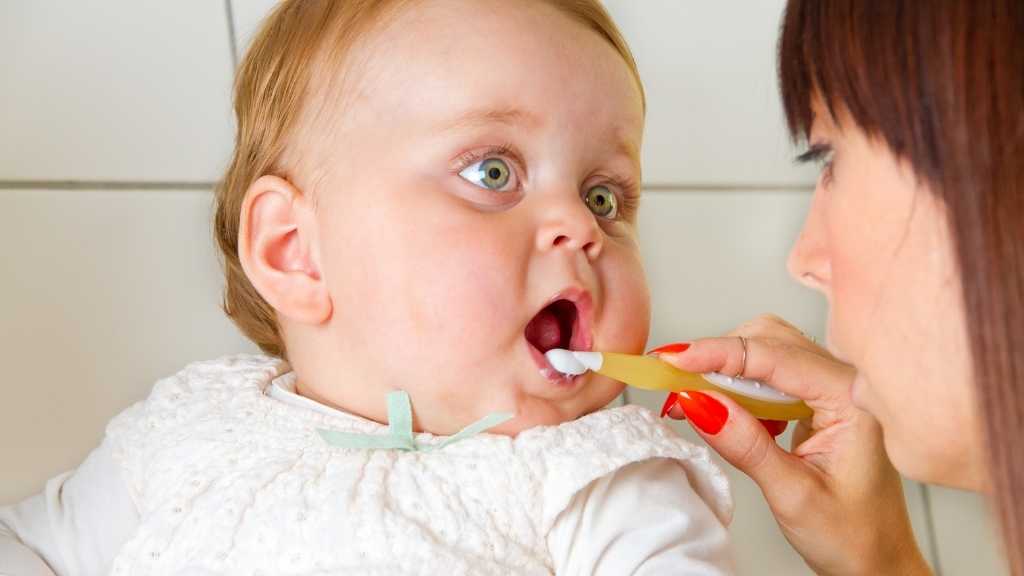
Second, start oral health care early. Even before the first tooth comes in, wipe baby’s gums with a clean gauze pad or towel after each feeding. Begin brushing the teeth with water as soon as the first tooth appears in the mouth.
Finally, talk to a pediatric dentist about scheduling the child’s first dental visit. Regular dental checkups, at an early age, get your child comfortable with visiting the dentist and play a big role in preventing tooth decay. It’s an important step in building healthy, beautiful smiles for life.
The Canadian Dental Association, Canadian Academy of Pediatric Dentistry and American Academy of Pediatric Dentistry encourages the assessment of infants, by a baby dentist, within 6 months of the eruption of the first tooth or by one year of age. It is by this time that all the factors exist for a cavity to potentially form (i.e. a tooth, sugar and cavity-causing bacteria). It’s best for your child to visit the dentist before there is a problem with his/her teeth.
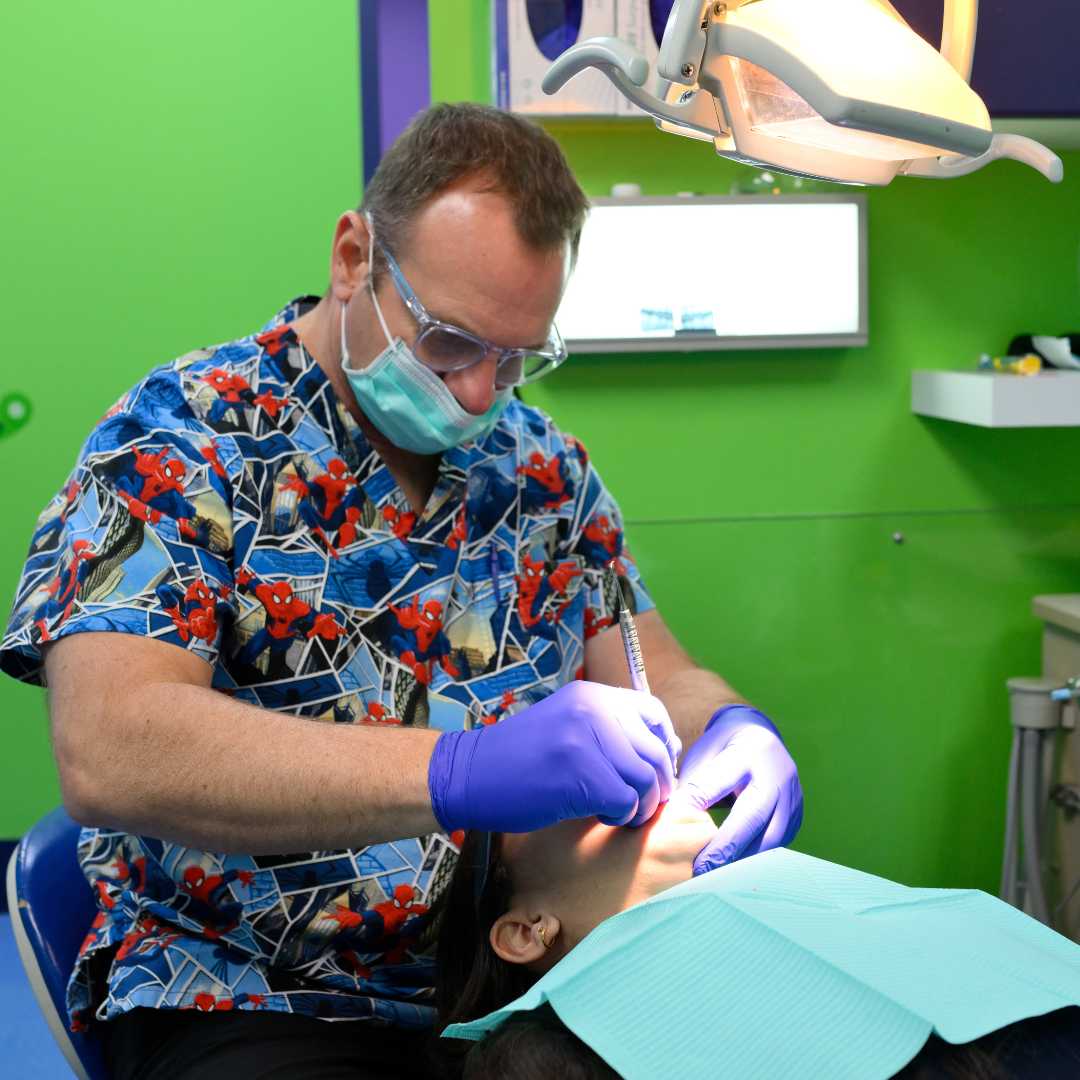
During this first exam, we will give your child a comprehensive dental check-up that includes an assessment of the health of the teeth, gums, the roof of the mouth, floor of the mouth, tongue, lips, cheeks, and overall bite development. We also perform an evaluation of the extra-oral (outside of the mouth) environment. Our staff will discuss ways to help reduce or remove items in the diet (such as breast milk and bottles containing milk or juice before bedtime) that may lead to decay at an early age.
Tooth decay is the number one chronic childhood illness and the most common disease in children today. It is five (5) times more common than asthma and seven (7) times more common than hay-fever (common allergies). It is also a totally preventable disease.
We always try to involve parents in an infant oral exam by having them assist in the knee-to-knee exam. This partnership sends the message to your child that dental care is important. It also stresses to parents that infant oral care needs a team approach.BOOK NOW
“Why do baby teeth need care and attention?”
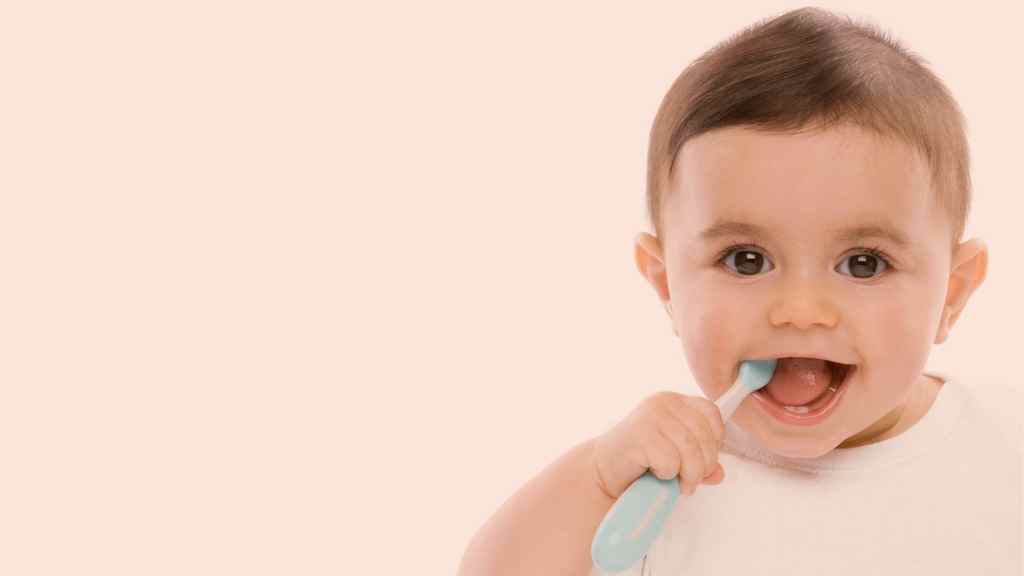
A common question asked by parents is, “Why do we need to fix baby teeth when they are going to fall out anyway?” There are many reasons dentists check baby teeth, all of which are important to a child’s current and future health.
When do baby teeth fall out?
Your memories of childhood regarding the loss of your own baby teeth may be cloudy. Although you know they were lost, you may be unsure when it happened. Were you two years old, or four years, or six or nine? Or was it later than that?
Normally, the first teeth children loose are the baby front teeth and this occurs about six or seven years old. From this age until your child reaches about age 13, the remaining baby teeth are lost and replaced by adult teeth. The final baby teeth are lost when the second baby molars are replaced by the permanent second bicuspids.
There is a pattern of loss that primary teeth follow in order to ensure the adult teeth come in the most favourable position. If one or more baby teeth are lost too early, it can delay or dramatically affect the position of adult teeth, and braces may be needed to correct this. Sometimes, however, baby teeth do not fall out (exfoliate.) This may be a result of several conditions. There may be no adult tooth ready to replace the baby tooth. A misguided successor tooth may be disrupting the process – this often occurs when your child’s teeth are crowded.
Lastly, the root of your child’s baby tooth may be attached to the bone itself, a problem called ankylosis.
It is important all children have a complete dental examination at an early age to confirm all adult teeth are present. If an adult tooth is missing or delayed, you can learn the options available to ensure the best care of your child’s dental condition.BOOK NOW
“What should I know about cavities?”

Baby teeth, like adult teeth, develop cavities. If left untreated long enough, this can lead to a life-threatening infection.
For a cavity to develop in children or adults, three factors must be present.
Firstly, bacteria called mutans streptococci are needed. These bacteria start to live in your child’s mouth when the first tooth erupts about the age of six months. Before this time, the specific bacteria are not present.
The second factor required is a tooth.
Finally, sugars are needed for the bacteria to eat. This includes fruit sugars (fructose,) milk sugars (lactose,) as well as candy sugars (glucose and sucrose.) As we know, the foods most enjoyed by children are the ones which are highest in these sugars. Children who often eat sticky foods containing sugar or who sleep with a bottle (bottle cavities) are at the greatest risk for developing cavities.
Once these sugars are digested by the bacteria, acids form and cause the decay of the tooth. It is only in the earliest stages of cavity formation that the process can be reversed with fluoride. Once the outer surface of the tooth breaks down, the cavity will not ‘go away.’ It will only worsen.
The decay continues until the cavity reaches the nerve (pulp) which is found in all teeth. Once there, the nerve becomes infected and dies. This is of great concern because the infection can spread throughout the body and cause a life-threatening infection. If you notice any swelling in the mouth or difficulty breathing and swallowing, it is extremely important that you call a dentist or medical doctor as soon as possible. The swelling may be an indication of a life-threatening infection caused by an advanced dental cavity.
Children who develop cavities experience pain, but may not have the right words to tell you. Restless nights, weight loss and a poor disposition are often indications that your child has a cavity needing treatment. It is important to consult a dentist if you suspect this is the case.
Also if you notice any discolouration of your child’s teeth, check with your dentist. This may be an indication of a problem with the teeth. Because all the factors which cause cavities are present when your child’s tooth erupts, children should be seen by a dentist at this time or earlier. It is not recommended to wait until the child is three years of age to see the dentist for the first time.
What is the value of baby teeth?
Baby teeth have an important role to help guide adult teeth into their correct positions.
When these first teeth are maintained well and kept in their position for the appropriate length of time, adult teeth are able to follow properly. If a baby tooth is lost prematurely, several problems can occur.
These may include:
- The shift of the next tooth into the newly created space. This leads to crowding.
- A delay in the eruption of its succeeding adult tooth.
- Healthy baby teeth are necessary for your child’s growth and development. Unless cavities are treated, children may be unable to eat properly and may experience weight loss and poor overall development. As a result, they will lack enough of the necessary building blocks needed to preserve their overall health.
- Baby teeth are necessary to ensure a child’s speech develops properly. Without teeth, your child will be unable to form various sounds such as “th” and “f.”
- Finally, baby teeth are needed to give your child a beautiful smile. We all want to feel good about ourselves. Your child’s ability to flash a winning smile from an early age will go a long way to promoting that needed self esteem.
My baby sucks his / her thumb. Is this bad for teeth?
Babies have a natural sucking reflex and doing so helps them to relax. By age one, however, it is recommended that children stop using a soother and are discouraged from sucking on a thumb.
As a general rule, the teeth will position themselves where the pressures of the tongue, lips and cheeks all balance. When this balance is disturbed, such as when a child sucks a thumb or uses a soother, the pressure that results from this habit can overpower the normal balances in the mouth and cause the bite to mold itself around the thumb or soother.
How frequently, how intensely and how long a child keeps this habit going (or how much they “love doing it”) will determine the amount of change that occurs. These factors will also determine how hard it will be to stop the habit as well as the extent of the change to the bite.
Bite correction and habit management may be needed depending on the amount of change that is seen at your dental visit.
In terms of dental health, it’s important to never put sugar, honey or corn syrup on a soother as this can cause cavities. The same is true for allowing your baby to sleep with a bottle in his/her mouth.